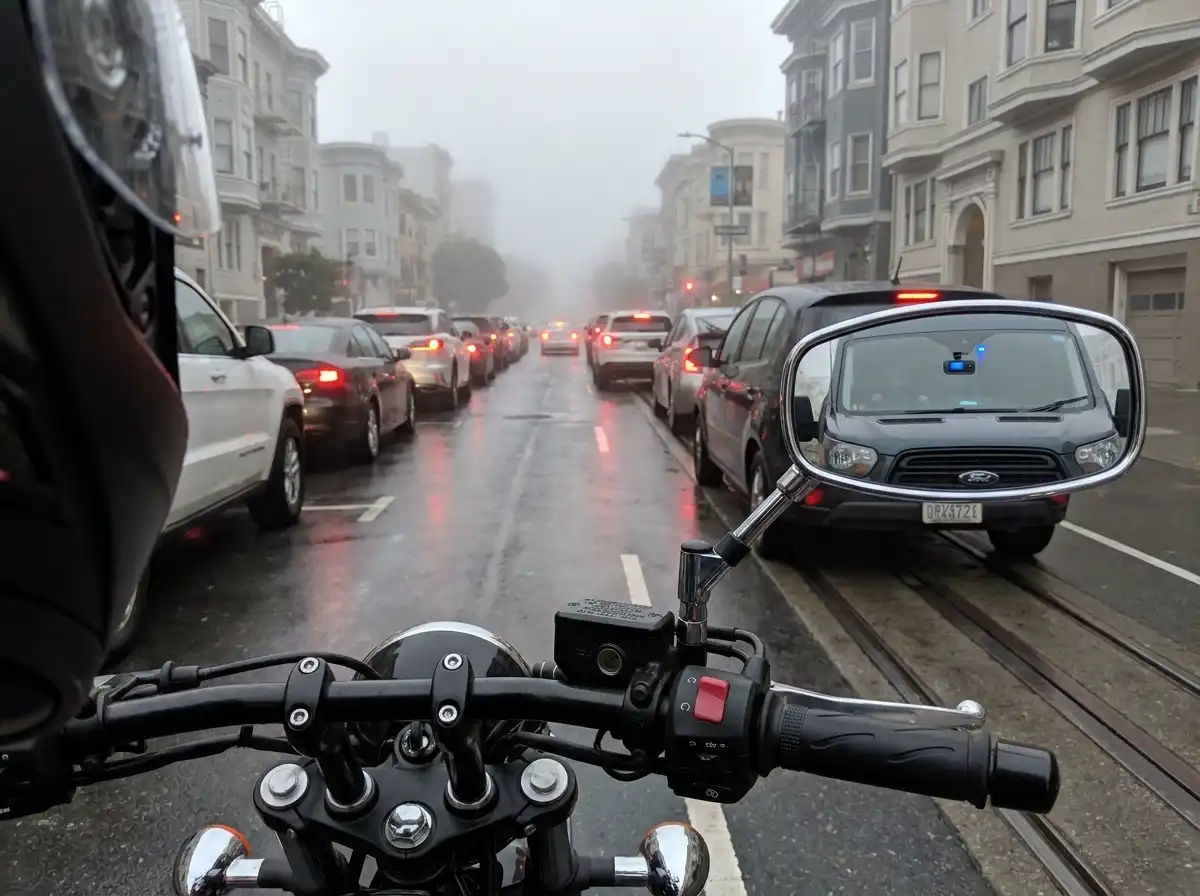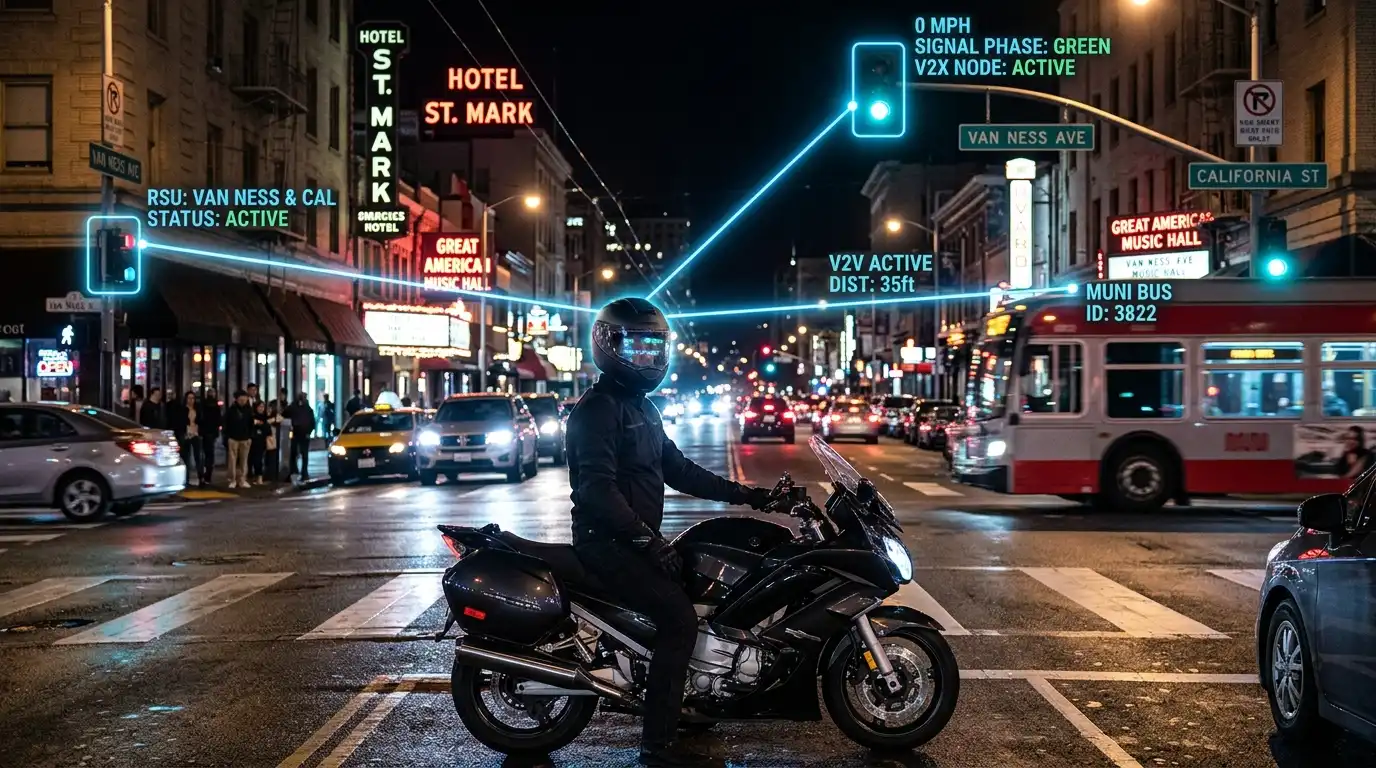
Intersections in San Francisco present some of the most dangerous riding environments in California. Dense urban corridors like Market Street, Geary Boulevard, and Van Ness Avenue feature complex light phases, heavy pedestrian foot traffic, commercial delivery vehicles, and constant transit buses. For motorcyclists, the risk of a severe collision is highest at these junctions, where drivers executing left turns routinely fail to yield the right-of-way.
In traditional personal injury litigation, insurance adjusters frequently exploit the lack of objective physical evidence to blame the motorcyclist. Claims adjusters routinely assert that the rider was speeding, aggressive, or distracted. However, the rise of smart helmet HUD (Heads-Up Display) telematics integrated with San Francisco’s municipal Vehicle-to-Everything (V2X) traffic grid has changed how motorcycle intersection crashes are investigated and litigated. Today, motorcyclists can leverage cryptographic, timestamped sensor logs to defeat comparative negligence defenses and prove fault with precision.
The Danger of Intersection Left-Turn Collisions in San Francisco
 Under California Vehicle Code (CVC) § 21801, any driver intending to turn left or make a U-turn must yield the right-of-way to all vehicles approaching from the opposite direction that are close enough to constitute an immediate hazard. Despite this clear statutory mandate, left-turn broadside collisions remain the leading cause of catastrophic motorcycle injuries and fatalities across the Bay Area.
When an automobile turns directly across an oncoming rider’s path, the defense insurance carrier almost always asserts comparative fault under California’s pure comparative negligence system (Li v. Yellow Cab Co.). Defense arguments typically center on three claims:
- Alleged Speeding: Claiming the motorcycle was traveling significantly above the posted speed limit, making it impossible for the turning driver to gauge arrival time.
- Distracted Riding: Arguing the rider failed to observe the turning vehicle in time due to inattention.
- Lack of Evasive Action: Asserting the rider had sufficient time and distance to brake or swerve but failed to do so properly.
Without independent video or sensor telematics, these cases often devolve into a “he-said, she-said” battle where anti-motorcycle biases can unfairly diminish the value of a rider’s claim.
The Evidentiary Power of Smart Helmet HUD Telematics
Modern smart helmets are equipped with integrated Bluetooth HUD visors, multi-axis gyroscopes, accelerometers, GPS tracking chips, and high-frame-rate dual camera arrays. Rather than serving merely as convenience devices, these systems collect continuous telemetry that reconstructs the crash sequence second by second.
In personal injury claims, smart helmet telematics provide key objective evidence:
1. Exact Velocity and Deceleration Logging
Internal GPS and multi-axis accelerometer logs capture the motorcycle’s exact speed trajectory prior to impact. This data can definitively disprove allegations that the rider was speeding or accelerating recklessly toward the intersection.
2. Lean Angle and Evasive Maneuver Mapping
Gyroscopic telematics record exact lean angles and sudden swerve vectors. If a rider attempted an emergency evasive maneuver to avoid a left-turning vehicle, the helmet’s inertial measurement unit (IMU) logs the exact millisecond and magnitude of that physical input.
3. Dual-Angle 4K Visual Proof
Forward-facing and rear-facing helmet cameras capture high-bitrate video complete with embedded GPS coordinates and speed overlays, establishing the exact traffic signal state (e.g., solid green light) at the precise instant the negligent vehicle breached the intersection.
Rebutting the “Distracted Helmet Display” Defense
As smart helmets have grown in popularity, insurance defense teams have developed a new counter-argument: asserting that the helmet’s internal Heads-Up Display violated California’s distracted driving laws.
Under California Vehicle Code (CVC) § 23123.5, driving a motor vehicle while holding or operating a handheld wireless telephone or electronic device is prohibited unless the device is designed for hands-free operation. Insurance adjusters frequently claim that a visual HUD overlay projected onto a helmet visor distracts the rider, creating per se comparative negligence.
Experienced motorcycle accident attorneys counter this argument through specific legal and technical strategies:
- Compliance with DOT and Federal Standards: Demonstrating that consumer smart helmet HUDs project passive, focal-infinity safety telemetry (such as speed and navigation prompts) that do not obstruct the rider’s field of view or require manual screen interaction.
- Establishing Hands-Free Operation: Proving the helmet’s HUD operated via voice commands or automatic sensor triggers, fully satisfying CVC § 23123.5 hands-free exemptions.
- Biomechanical Causation Analysis: Utilizing biomedical expert testimony to prove that visual focal shift to a transparent HUD takes less than 0.1 seconds—substantially faster than checking a traditional motorcycle instrument cluster.
Corroborating Telematics with San Francisco’s V2X Smart Grid
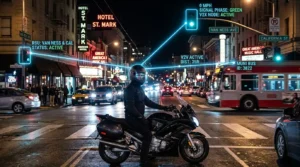
San Francisco’s smart corridor infrastructure integrates Vehicle-to-Everything (V2X) transceivers along major arterial streets. Smart traffic signals, roadside units (RSUs), and municipal transit vehicles continuously broadcast and log Signal Phase and Timing (SPaT) data.
When a smart helmet connects to or records near a V2X-enabled corridor, plaintiff attorneys can cross-reference the helmet’s telematics log with municipal signal data. Synchronizing these two independent data sets allows attorneys to establish critical facts:
- Signal Phase Verification: Proving the rider entered the intersection on a valid green light while the left-turning vehicle failed to yield on a flashing yellow or solid green circle.
- Vehicle Proximity and Line-of-Sight: Utilizing municipal RSU sensor logs to show that the defendant’s vehicle had an unobstructed line of sight to the oncoming motorcycle for several seconds prior to initiating the turn.
Preserving Critical Evidence After an Intersection Collision
Digital telematics evidence is time-sensitive. Smart helmet memory cards can be overwritten, and municipal V2X logs are frequently purged on short retention schedules. Riders involved in a collision should take immediate action:
- Secure the Physical Helmet and Memory Card: Do not wipe, edit, or re-record over the helmet’s internal storage. Power down the unit immediately after the crash to preserve cached log files.
- Maintain Mobile App Cloud Synchronization: Ensure that the smartphone application linked to your smart helmet syncs its telemetry files to secure cloud backup servers without modifying file metadata.
- Serve Immediate Preservation Notices: Work with specialized legal counsel to issue California Public Records Act (CPRA) requests and formal spoliation letters to the City of San Francisco and Caltrans to preserve traffic camera and V2X sensor logs before automated overwrites occur.
Conclusion
The combination of smart helmet HUD telematics and San Francisco’s V2X traffic grid provides motorcycle riders with objective tools to combat unfair comparative fault claims. By capturing real-time speed, lean angle, and intersection signal data, injured motorcyclists can disprove allegations of speeding or distraction, hold negligent turning drivers accountable, and secure the compensation required for complete recovery.