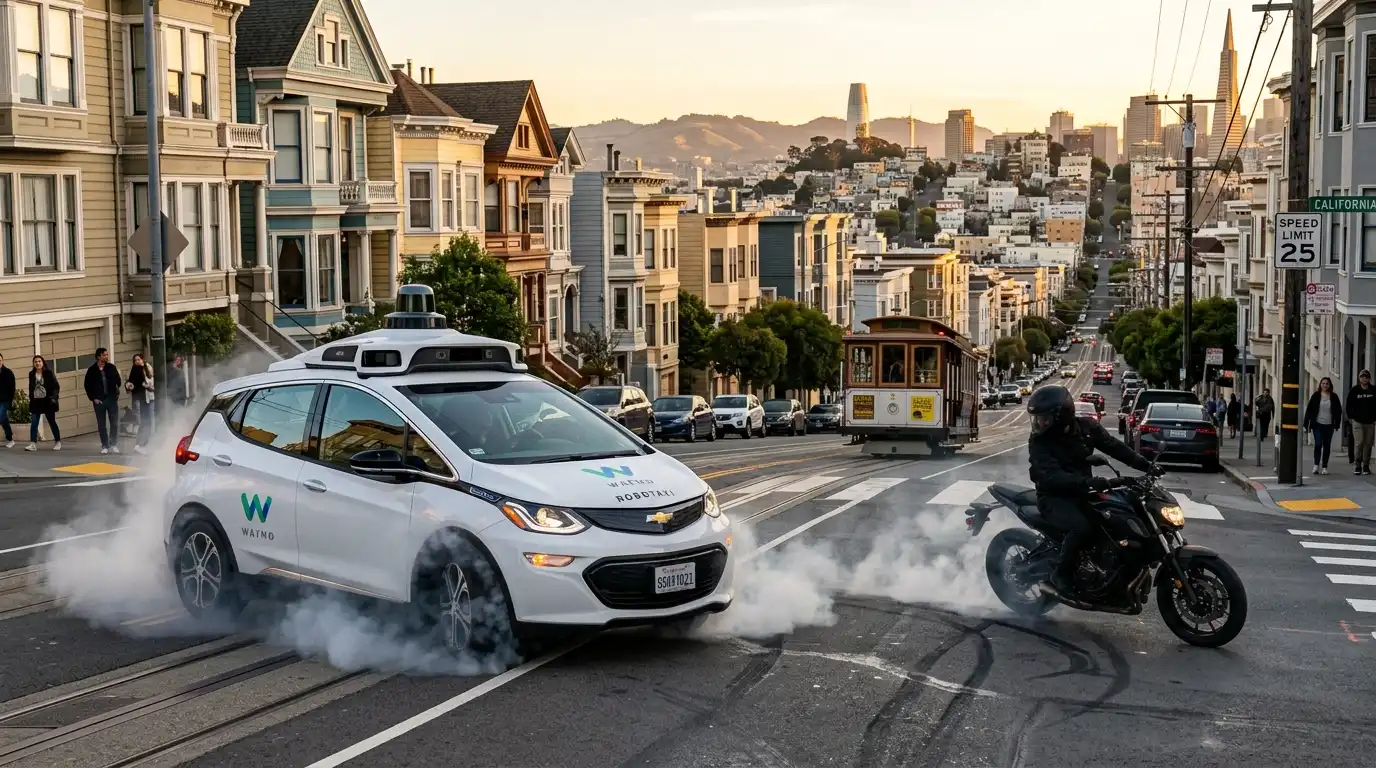
While self-driving technology promises a future free from human error, the reality on San Francisco streets is far more complex. Software glitches, blind spots, optical occlusions, and sudden system disengagements frequently force driverless vehicles into erratic behavior. When a multi-thousand-pound autonomous vehicle fails to detect a motorcycle, cuts across a lane during a turn, or slams on its brakes unexpectedly, the rider faces devastating physical consequences.
Establishing legal responsibility when there is no human driver behind the wheel requires an understanding of evolving state statutes, product liability, and complex digital forensics.
1. The Mechanical Reality: Why Robotaxis Fail to Detect Motorcyclists
Autonomous vehicles rely on a fused sensor suite composed of LiDAR (Light Detection and Ranging), Radar, and optical cameras paired with machine-learning perception models. While these systems excel at detecting large, predictable objects like passenger sedans or municipal buses, motorcyclists present a distinct challenge for early-generation perception algorithms:
- Narrow Physical Profiles: From a straight-on or rear perspective, a motorcycle presents a significantly smaller visual and radar cross-section than a passenger car. Algorithms trained on standard vehicle profiles can misclassify or briefly “drop” a tracking marker on a motorcyclist.
- Lane-Splitting and Lane Filtering Awareness: Lane-splitting is fully legal under California law (CVC § 22400). However, autonomous driving systems designed primarily in controlled simulations often struggle to anticipate a motorcycle moving between lanes of traffic at moderate speeds.
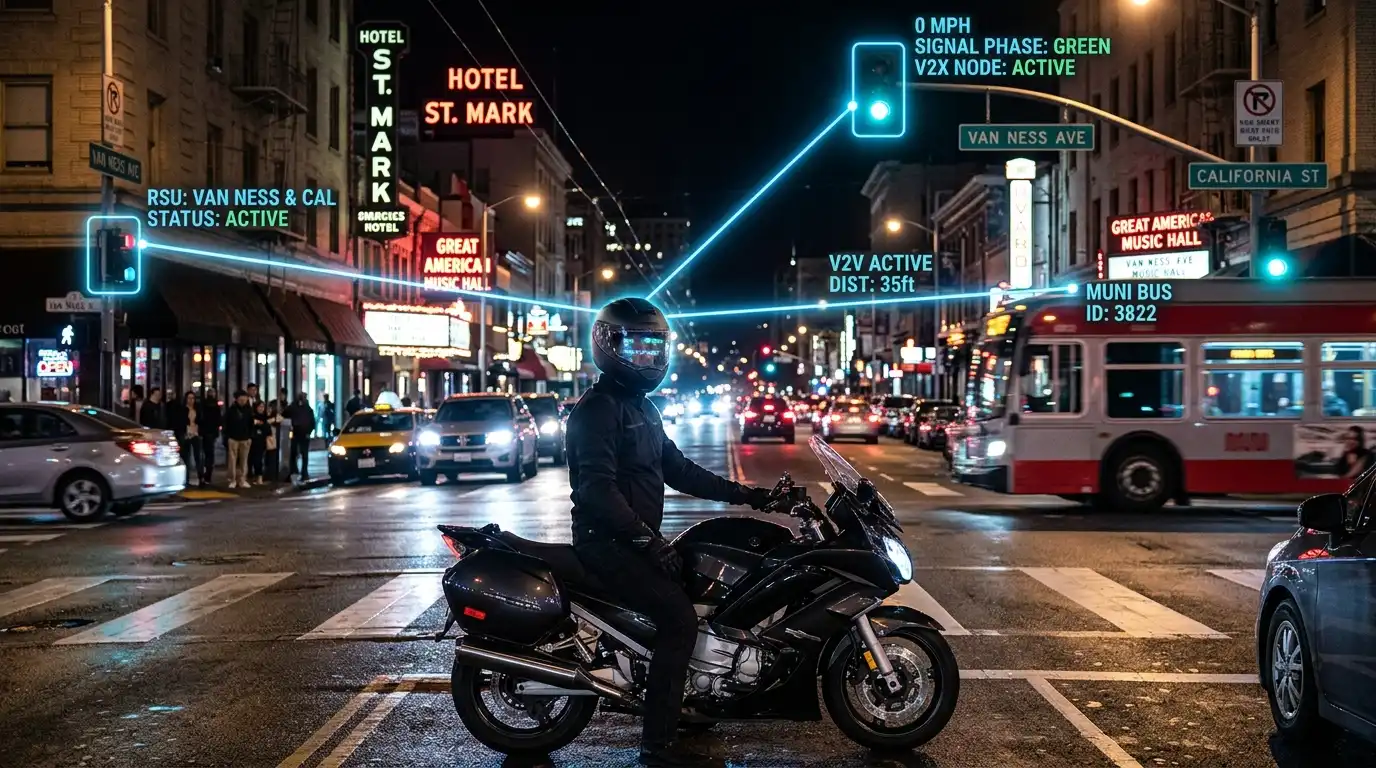
- Occlusion in Complex Urban Environments: On crowded San Francisco thoroughfares like Market Street, Van Ness Avenue, or Geary Boulevard, delivery trucks and commercial vehicles frequently obstruct optical sensors. If a robotaxi’s perception stack fails to maintain object persistence, it may initiate a turn or lane change directly into an oncoming rider.
2. Liability Framework: Product Liability vs. Third-Party Negligence
In a standard motorcycle crash, liability centers on proving that a human driver breached their duty of care through distraction, speeding, or failure to yield. When a driverless vehicle causes a crash, the legal foundation shifts toward corporate entity accountability and product liability:
A. Commercial Fleet Operator Negligence
Autonomous vehicle fleet operators function as commercial transport providers in California. If a company deploys a software update with known perception bugs, fails to calibrate sensor pods, or operates outside safe environmental conditions (such as dense San Francisco fog), the corporation itself may be held directly liable for negligent operations.
B. Software and Hardware Product Liability
If a crash is caused by a system defect—such as an algorithmic failure to calculate a motorcycle’s speed or a sudden software freeze—the case may involve strict product liability. Under California product liability law, a manufacturer or software developer can be held responsible if a product’s design or manufacturing makes it unsafe for its intended use.
C. Remote Operator Intervention Errors
Under regulations established by the California Department of Motor Vehicles (DMV) Autonomous Vehicle Program, fleet operators maintain remote assistance centers where human operators can provide guidance to routing systems when a vehicle encounters road hazards or construction zones. If a remote operator issues an unsafe instruction or fails to override a dangerous vehicle trajectory, their actions create an additional avenue of vicarious liability.
3. Navigating California’s Regulatory Requirements and Safety Statutes
California continues to refine its regulatory oversight of commercial driverless fleets. Following the passage of key public safety updates—such as California Assembly Bill 1777—the state has enhanced requirements governing how driverless vehicle fleets must interact with local infrastructure and law enforcement:
- Official Notices of Non-Compliance: Peace officers and traffic enforcement authorities in San Francisco can issue official non-compliance citations to autonomous vehicle manufacturers for moving violations, including failure to yield right-of-way to a motorcyclist. These citations provide immediate, objective evidence of a traffic law breach.
- Mandatory Emergency Communication Links: Driverless vehicles operating in California must maintain two-way voice communication systems and dedicated emergency response lines, ensuring that first responders can interact directly with remote personnel at crash scenes.
- Crash Reporting Mandates: Manufacturers operating under California DMV permits are legally required to report every collision involving an autonomous vehicle that results in property damage, bodily injury, or death within strict reporting timelines.
4. Securing Telemetry Data: The Role of Digital “Black Box” Forensics
In traditional personal injury claims, liability disputes often come down to conflicting witness statements. In an autonomous vehicle collision, liability is overwhelmingly determined by digital data. Autonomous vehicles log vast quantities of high-resolution operational data every second.
Securing this evidence immediately following a crash is critical:
- Raw LiDAR Point-Clouds and Camera Feeds: The vehicle’s external sensor logs reveal precisely what the vehicle’s perception system “saw” in the seconds leading up to impact, demonstrating whether the system recognized the motorcycle or misclassified it as background noise.
- Object Bounding Boxes and Trajectory Predictions: Autonomous driving software draws bounding boxes around detected objects and calculates their predicted paths. Examining these logs can prove whether the vehicle’s planner failed to yield because it miscalculated the motorcyclist’s speed or trajectory.
- System Logs and Remote Communications: Internal logs show whether the autonomous system experienced a disengagement, issued an internal error flag, or received input from a remote human operator immediately before the collision.
Crucial Legal Step: Because autonomous vehicle companies control access to their proprietary internal server logs, your legal team must issue a formal Spoliation of Evidence Letter immediately after the incident. This legal demand requires the fleet operator to preserve all unedited raw sensor files, tele-operation voice logs, and onboard telemetry before automated data overwrite protocols take place.
Steps to Take Following an Autonomous Vehicle Motorcycle Crash in SF
If you or a loved one are involved in a collision with a driverless vehicle anywhere in San Francisco, taking immediate steps helps safeguard both your physical health and your legal rights:
- Request SFPD On-Scene Investigation: Contact law enforcement immediately. Ensure the responding officer files a formal traffic collision report and explicitly documents that the involved vehicle was operating in autonomous mode without a human driver present.
- Document the Vehicle’s Physical Identifiers: Take photos of the autonomous vehicle’s license plate, vehicle identification number (VIN), fleet identification numbers (often displayed on the sides or rear bumper), and the condition of the external sensor pods.
- Gather Eyewitness Contact Details: Bystanders, pedestrians, and other drivers who observed the crash can offer independent testimony confirming that the driverless vehicle pulled out unexpectedly or performed an unsafe maneuver.
- Seek Immediate Medical Care and Track Symptoms: Motorcycle crashes frequently cause hidden traumatic injuries, including concussion, soft tissue damage, internal bleeding, and spinal fractures. Obtaining an immediate medical evaluation establishes a direct, documented link between the collision and your injuries.
- Consult a Specialized Personal Injury Attorney: Pursuing a claim against a multi-billion-dollar technology enterprise requires experienced legal counsel familiar with Northern California traffic regulations, product liability laws, and digital evidence preservation.